Monday, September 17, 2012

Pictures of Molecular Bonds

Photography!  You know a little bit about it, right?  You get a film or screen or some such, let some photons hit it for a while, and voila, you got yourself an image.

but you know about photons too.  You know that if something is small enough, the momentum of photons is likely to knock them about.  You may even know that the resolution is restrained by the wavelength of the photon - the longer the wavelength, the less their resolving power.  Think of it like pixels - the larger the pixels, the worse the image.  So how do you take a photo of something very, very tiny?  You use something with a shorter wavelength, of course.

Like electrons!  See, you could use visible light, around 400-700nm (billionths of a meter) to see...well, all the things you see, or X-Rays, at 0.01-1nm to go through tissue and bounce off denser material such as bone.  But these are still general surfaces, much too blunt for our purposes.

First "medical" X-Ray image: Roentgen's WIFE'S hand.
Not what I would call chivalrous. (wiki)

Monday, September 10, 2012

Gravity's Effect On Perception

You may have, at some point in your life, noticed gravity.  Good!  It's super-important.

Gravity has been with us for our entire biological evolution.  Thus it only stands to reason that our biology would, when possible, take advantage of its influence.  For instance, since gravity on Earth is always pointing downward (technically inward, as a central force), it makes for an extremely reliable vertical compass.

FUN FACT:  the strength (and indeed, even direction) of gravity on the Earth's surface actually varies from location to location, dependent on factors like altitude, the local topography (say you had some mountains nearby) and geology (distribution of density).

Sauce
Local gravity can even change over time, due to differences in water levels and such.  Here's the gravity in South America shifting as the floods and recedes (holy snickerdoodles we're smart enough to watch gravity change from space):


Oh right I was going somewhere with this.

So, important and unavoidable as it is, gravity has been a perpetual influence in our evolution.  How else would you walk and balance yourself, how else would you know the orientation of your head, if not for an ever-present acceleration?

It also makes sense that gravity's influence would have seeped into other aspects of our brain.  Here we get to the whole point of this post: scientists conducted some visual illusion experiments on astronauts before, during and after trips into space, and found an interesting trend concerning vertical perception of these illusions.

Here's the Inverted-T illusion (wherein each line is actually the same length), with a graph detailing the perceived size difference by participants at various times:


They also asked participants to draw squares and crosses, measuring the horizontal-to-vertical ratio.


The extremely wide error bars are due to the small sample size, but the trend exists nonetheless.  As they spend time in space, a seemingly gravity-induced perception of vertical length dissipates.

One of the primary causes of speciation (if not the primary cause) in biology is some sort of geographic or geologic separation.  I can think of no geographic separation more significant than departing the planet altogether.  As people take longer and longer trips (longest cumulative time belonging to Sergei Krikalev with 803 days), it will be interesting to see the effects on human physiology and psychology, and how that will confer benefits and differences.  Sure, bone and muscle density decreases, but who needs bones in space?

h/t Neuroskeptic (amidoingitrite?)

Thursday, September 6, 2012

Wicked Coronal Mass Ejection

So there was a gigantic explosion on the Sun the other day:


First of all: good gravy that is beautiful.

These cooled filaments (this one half a million miles long) are masses of charged particles held in place by the Sun's magnetic field.  The Coronal Mass Ejection you see takes about an hour, and is traveling at 900 meters per second (about 2000 miles per hour).

Here's pictures at four different wavelengths (all in the X-Ray spectrum):


The variety of wavelengths helps scientists watch the change and distribution of temperature.

Even though it was directed away from us, the blast expands spherically, so we did catch some of the ejection about four days later, resulting in even more beauty, as charged particles smash into the Earth's atmosphere and emit Bremsstrahlung ('braking') radiation:


It's enough to make you think there might be something slightly dangerous about a slow, fiery nuclear explosion the size of 100,000 Earths.

http://www.nasa.gov/mission_pages/sunearth/news/News090412-filament.html

Sunday, September 2, 2012

How Energy Conservation Has Nothing To Do With Souls


Yanno what gets exhausting?  Hearing people apply one tiny little bit of scientific knowledge that they do not understand to explain away their mystic nonsense.  I try to be understanding – I get that it's hard to blame someone for not knowing what they don’t know.  But goddamn.

The conservation of energy is something I’m sure many people have heard of.  It’s an important principle – no matter the interaction, the total energy at the beginning is the same at the end – with vast and very useful applications (vast here meaning every phenomenon everywhere).  There are in fact many conservation laws – linear and angular momentum, spin, quantum number.  Even probability in quantum mechanics is conserved!  Unsurprisingly, I don’t hear about people abusing those laws too often.

How do people abuse their limited knowledge of energy conservation?  It goes something like this:

Energy is conserved, I don't want to believe I really die when my body dies; ipso-fucking-facto: souls/reincarnation/eternal life/take your pick.

Totally real.

I am not, near as I can tell, oversimplifying this stance.  This idea that we – the self, the ego, the mind – are energy, and since energy is always conserved, surely our souls must live on after death.  Why, it’s conserved!

There are two ways to interpret this idea meaningfully, both wrong, but differently.

One, which is an idea I myself subscribe to, is that our minds are a particular configuration of energy.  A specific wavefunction, a well-structured architecture generating subjective experience.

In this scenario, they are wrong because configurations are not conserved.  The strict organization of your mind at this moment does not reflect the organization of all that energy 20 years from now.  Really, even 20 minutes from now – that energy is being shuffled around and used and emitted through chemical and electrical reactions.  Reactions that are changing the configuration.  Meanwhile heat energy dissipates from your brain, heat energy that I doubt anyone would refer to as their self.

The other way is to suggest that there is something special or significant in the energy they are considering.  The problem here is that energy changing forms is exactly the significance of the principle.  If a ball hits another ball and just transferred kinetic energy into more kinetic energy, nobody would be surprised (I hope).

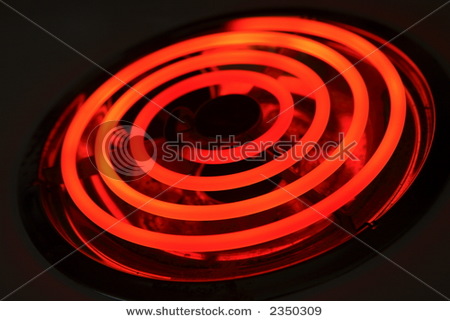
But!  When you hammer a nail into a board, the nail gets hot because some of that kinetic energy you just knocked into it caused frictional interaction between the nail and the board, jostling around the molecules which then dissipate this excitement through heat.  In fact, if you were to hit it hard enough (insanely hard), that energy would be sufficiently high that the photons radiating would be within the visible spectrum.  This is what's happening when electrical current is dissipated into heat on your stove.

Above: a stove with a spirit leak.

Thus, if this mind-energy is special, and somehow stays in it's own form as it shits out of your dead-ass head, well then, that has nothing to do with conservation of energy, it is in fact something else entirely.  Which is fine by me.  Talk about your own voodoo magic on your own time.  But don't co-opt scientific ideas just to pretend your idea has any legitimacy.  It's downright rude.

Energy is one of those unfortunate words that has a well-established foot in both colloquial and scientific languages.  We all "know" what the word means, we use it on a regular basis.  So people can make the mistake of applying the definitions of the scientific version to their own.  But when science defines a word, it defines the shit outta that word.  There's no room for interpretation, no poetic license.  Cut the malarkey, folks.


I know I've been gone for a while; I'm sorry, and you sweet people deserve better.  I'm a changed man.  I'm gonna make you coffee in the morning, and wash my own clothes, and stop muttering 'bitch' under my breath whenever you bring up your mother.  Also, I'm gonna update regularly.  September?  More like Superber!  Shit yeah!

Friday, July 20, 2012

Term O' The Day

Thagomizer: an informal name for the distinctive arrangement of four to ten spikes on the tails of stegosaurid dinosaurs.

The term "thagomizer" was coined by Gary Larson in a 1982 Far Side comic strip, in which a group of cavemen in a faux-modern lecture hall are taught by their caveman professor that the spikes were named "after the late Thag Simmons". The term was picked up initially by Ken Carpenter, a palaeontologist at the Denver Museum of Nature and Science, who used the term when describing a fossil at the Society of Vertebrate Paleontology Annual Meeting in 1993.
Thagomizer has since been adopted as an informal anatomical term, and is used by the Smithsonian Institution, the Dinosaur National Monument in Utah, the book The Complete Dinosaur and the BBC documentary series Planet Dinosaur.
Nice.

The Far Side almost certainly holds the number one spot for comics taped up on the doors of scientists.

Friday, July 13, 2012

Dark Matter Filaments

Apologies for the radio silence here at Chez CK.  Attention was required elsewhere.  I've noticed a steady trend of people visiting this site each day (super exciting), which makes me feel guilty enough to make it up to you best I can.  We'll start with a little bit of news that was overshadowed by the "particle just like the Higgs but we're only 99.9999% sure it's the Higgs which isn't sure enough" discovery.

(Sauce) 
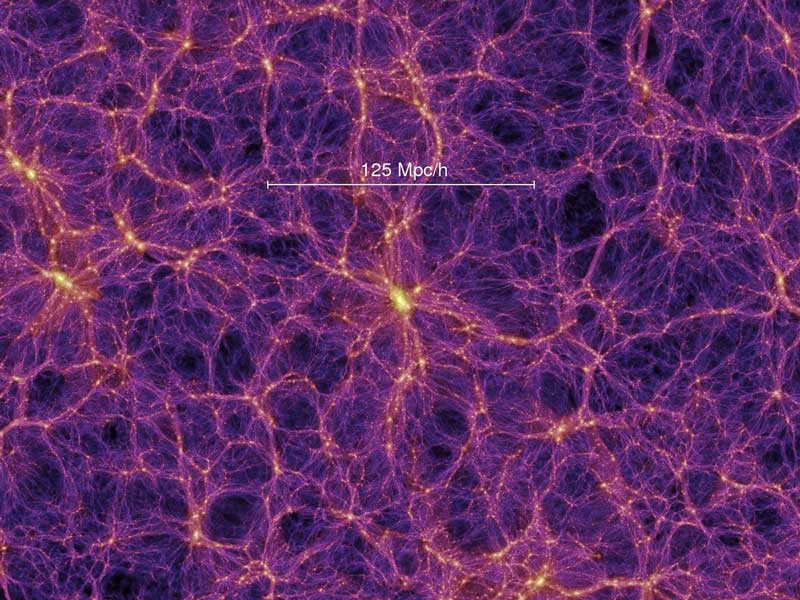
You've probably seen this picture make its rounds on ye olde internetes.  One is of neurons, the other is a simulated construction of the universe on an intergalactic scale.  I'm not here to compare them, but it's the most popular picture I know of that shows a distinct feature of the arrangement of galaxies - the filament structure between superclusters.

These filaments have been known for decades - I'm not sure when they were first spotted, but I'm sure it was in a galaxy survey not unlike this one:

Ploink
Where the redshift of galaxies is used to to determine distance.  This foamy, sponge-like structure is sometimes called the cosmic web, because everything astronomers name is badass.

HuffPo
This is not the type of thing light matter will tend to do on its own.  The Lambda-Cold (cold meaning slow enough to be non-relativistic) Dark Matter model posits that dark matter started in the universe as a web that light matter was attracted to, and thus began to collect along these filaments.  The distribution of dark matter wouldn't behave like the matter we're familiar with; it doesn't radiate photons so there's no temperature changes, it doesn't interact with electromagnetic fields, so it wouldn't bounce and jostle, or form molecules, and so on.

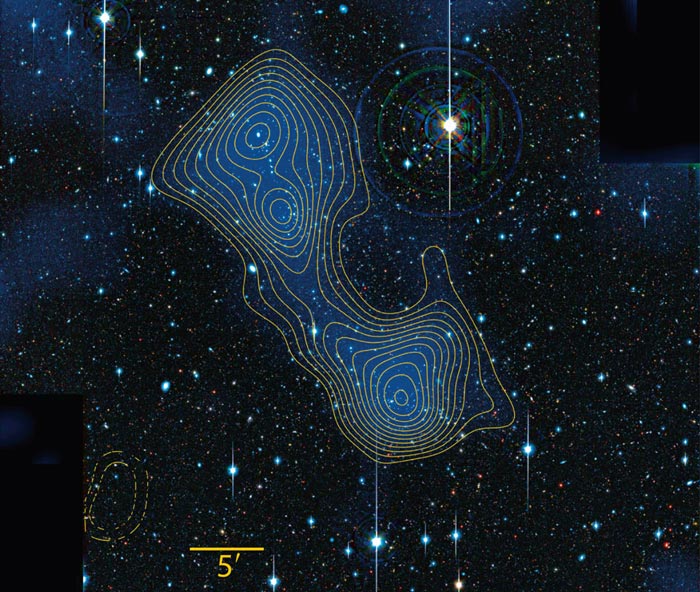
Anyhoos!  We found a filament.  The information came out at the same time as the Higgs announcement, so it got little play, but it's another brilliant discovery all the same.

(Physics World)
This is an image of the gravitational lensing of two galactic clusters, Abell 222 and Abell 223, and the lensing in between them.  This connecting lens also emits x-rays characteristic of hot gas, which would be expected to form along the filaments, but is too light to bend light as strongly as indicated.

It's not definitive, it doesn't completely eliminate competing models, it's no 99.9999% certainty, but discoveries in science often aren't.  A model is by it's nature created to explain a wide variety of phenomena, so it takes a wide variety of phenomena to verify.  And this is a great step in that direction.  Another piece of the puzzle, a little bigger than the others.

Tuesday, July 3, 2012

Brains Are Neat!

(Sauce)
Of course, you already knew that.

We all remember being a teen, smoking low-quality fatties with our pimply compatriots under the stars, asking impossibly irrelevant questions like 'what if god was a woman?' and 'you think Lincoln got stoned with former slaves?'  And, surely, someone brought up the idea that the red you see isn't the same red they see.

What a ridiculous notion!  We each have human brains, we went through similar development and construction of the basic areas of the brain.  Our respective color-determining cortices are at least similar enough that its a small step to assume our perceptions are likewise the same.  And we all seem to share similar emotional responses to similar colors.  Same wavelengths, same physiology, same reactions - sure, we may not find the answer anytime soon, but we can make some solid presumptions.

Obviously, I'm not the funnest person to have 'What if...' conversations with.  I can admit my faults.

And on the subject of admitting faults: it now seems likely that I was wrong.  My apologies, my young stoner friends.