 |
| "Hang on, Doc. I see something that makes no sense." |
Wednesday, April 17, 2013
Possible Dark Matter Detected
Dark matter, as you might gather from the name, is impossible to "see" (in the sense of reflecting light). Whatever it may be specifically, it most certainly doesn't seem to interact electromagnetically with any other particles. And so we turn to other forces to detect it - most notably gravity. It's existence was first inferred from the inexplicably high gravitational energy necessary for the observed speeds of galactic rotations (and the speeds of galaxies in clusters).

Wednesday, March 27, 2013
The Magic of Gyroscopes
"Somebody for the love of god explain to me how that works, how the fuck does that happen?"
- Bill Burr
Sure! I heard Bill bring this up on the Joe Rogan podcast, and since my intended next post is becoming more long winded than I hoped, I thought this would make for a nice subject.
Let's start with Newton's first law: objects in motion tend to stay in motion, and objects at rest tend to stay at rest, unless acted upon by some outside force (force is an important word here). This concept is at the core of inertia, the resistance an object has to change in it's behavior. There is a basic kind of inertia in reference to motion, with mass being the basic measure of an object's resistance. But there is also a rotational inertia, based on both the mass and the shape of the object, along with defining exactly which axis you are rotating the object around.
Once you start an object a'spinning, the combination of the angular speed and the rotational inertia defines the angular momentum. In the case of a wheel-shaped object spinning as the one in the video, this momentum can be imagined as an arrow pointing out from the axle (I know it's odd to imagine that the angular momentum is directed perpendicular to the actual rotation, but just trust me that it works out mathematically).
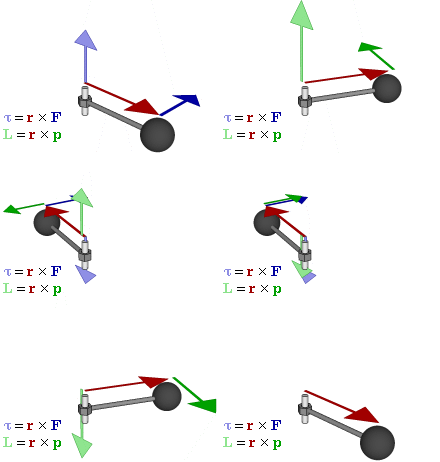 |
| L is the angular momentum. Torque (T) is the applied force. (wiki) |
By Newton's law, we know that this angular momentum, pointing outward, will resist any disturbances in it's speed or direction. And thus, so long as it is spinning fast enough (increasing the value of L), the wheel resists being pulled downward by gravity - indeed, tries to resist tilt of any kind. That outward arrow remains as constant as possible. This is exactly why it's easier to maintain balance on a bike when you're moving faster - below a certain speed, the angular momentum is overwhelmed by the forces of gravity. Likewise, a top, or that wheel above, as they slowed, would begin to fall as their resistance to a downward pull weakens.
 |
| You see that r in the above equations? That stands for radius, and a larger radius makes for a larger momentum/torque. And that's why those goofy Victorian bastards thought a giant wheel was a good idea. |
As gravity is a force, it is being applied perpetually, pulling and pulling ever downward. So, if you imagine the upward (rope) arrow staying constant, and the outward arrow of momentum trying to stay constant, the ever-pulling grip of gravity must somehow be answered, which the wheel does by slowly twirling around the rope, in a horizontal redirection of the downward force.
Hope that wasn't too difficult of a read. To technically understand the rotation of three dimensional bodies is surprisingly unintuitive.
"Science is like, it's incredible, isn't it?"
- Bill
Saturday, March 23, 2013
Fermions and Bosons
Welcome back and hello new friends! Let's ignore the lengthy gap between this post and the previous one and hop right on it, shall we?
The Higgs boson inferred from LHC experiments has been in the science news often lately - most recently they're now super-duper sure it's a Higgs, which is thrilling in that "oh snap, we were right" kind of way. And whenever you hear an explanation of what the Higgs is or does, you never really need to understand the boson to follow what they're saying.
So, what is a boson? This comes with a free complimentary question: what is a fermion? We start with the characteristic difference between them: spin.
On your first consideration, you may be insulted that someone would suggest you don't know what spin means. In all likelihood, if you're reading this, you have a computer chair. Ipso facto, you know what it means to spin.
But there's some qualities of this kind of spin that you take for granted: you have a size, and you're not rotationally symmetric. Electrons, for instance, do not have this luxury. What you think of as spinning is generally an orbital angular momentum - parts of you are orbiting around a central axis, that is, travelling in a circle. To oversimplify, the magnitude (strength) of this spin is defined by the speed the part is moving, multiplied by the distance of that part from the axis. This is the physics behind why doorknobs are as far from the axis of the door's rotation as possible: this larger distance minimizes the effort needed to actually open it.
So, how do you describe spin for an elementary particle with effectively no size, and no way to tell the back from the front? The 'distance' from the axis goes to zero, implying the orbit is also zero.
Classically, the proposition makes no sense. And yet in 1922, Stern and Gerlach were forced to suggest that these structureless particles nonetheless possessed an intrinsic angular momentum.
From Quantum Physics by Zettili (easily my favorite textbook on the subject, dense and complete):
This experimental result only made sense when one suggests that the particle carries an inherent angular momentum. Not only that, but this spin comes in discrete values. Imagine if you could only spin in your chair at specific speeds (lost in thought, too fast, and nauseating). And then forget that image, because you weren't actually spinning in any spatial direction, you merely contain "spin". Ridiculous, I know. As Zettili puts it, "The spin, an intrinsic degree of freedom, is a purely quantum mechanical concept with no classical analog".
As stated, spin comes in discrete values; specifically it comes in half-integer values - 0, 1/2, 1, 3/2, 2 (all multiplied by Planck's constant, as so many quantum characteristics are), and so on. Finally we approach the issue brought up at the beginning of this post: spin is the defining characteristics of bosons and fermions.
Bosons have "integral" spin; 0, 1, 2, etc. This class of particles most importantly contains the photon (and of course, the Higgs).
Fermions have spins like 1/2, 3/2, 5/2, etc, named "half-odd-integral spin" (because even halves like 2/2 is just 1). The most significant fermion is the electron, but also includes protons, neutrons and quarks.
So what's the importance of making this distinction?
Without getting into the details, having a half-odd or integer spin defines how you interact with other, identical particles. You can define a group of identical particles by a wave function, and a group of fermions (half-odd spin) has a wave function which is described as asymmetric (Figure a above), while a group of bosons would be described by a symmetric wave (b above).
In the symmetric case, nothing particularly interesting occurs; you can effectively stuff as many bosons as you want into one space, and the wave function accommodates them quite pleasantly, not unlike being able to add as many musical notes to a chord as you like. The wave abides.
However, in the asymmetric case, the wave function describing the state of multiple identical particles does a funny thing; if you pretend to put two fermions in the same state, the value of the wave function goes to zero. That is, such a wave function doesn't exist, can't exist, under the constraints of quantum mechanics. This results in the popular Pauli exclusion principle; try as you like, you simply can't stuff as many electrons as you like into one state: this exclusion repels the electrons away from each other, quite strongly. This "degeneracy" (multiple particles occupying the same energy level) is responsible for the relative "imperviousness of solid matter" in the case of electrons, and what keeps neutron stars from collapsing (as fermions, neutrons also are constrained by exclusion).
This principle is also the reason for electrons taking positions of increasing energy states in atoms. In fact, it is at the core of all atomic and chemical interactions. It defines much of the character of the periodic table as well. The rows are made by increasing the number of electrons within a "shell", with each subsequent row representing a larger shell, and each column representing similar "filling" of each shell. In fact, without this exclusion (that is, if electrons were bosons), the universe would be a very dull place indeed, as all the electrons of an atom would fall to the ground state, and all atoms would behave the same.
This all tells you pretty much nothing about the Higgs, but I hope it illuminates just a little bit more of the universe.
The Higgs boson inferred from LHC experiments has been in the science news often lately - most recently they're now super-duper sure it's a Higgs, which is thrilling in that "oh snap, we were right" kind of way. And whenever you hear an explanation of what the Higgs is or does, you never really need to understand the boson to follow what they're saying.
So, what is a boson? This comes with a free complimentary question: what is a fermion? We start with the characteristic difference between them: spin.
On your first consideration, you may be insulted that someone would suggest you don't know what spin means. In all likelihood, if you're reading this, you have a computer chair. Ipso facto, you know what it means to spin.
 |
| Go ahead, take a few spins right now. I'll wait. |
So, how do you describe spin for an elementary particle with effectively no size, and no way to tell the back from the front? The 'distance' from the axis goes to zero, implying the orbit is also zero.
Classically, the proposition makes no sense. And yet in 1922, Stern and Gerlach were forced to suggest that these structureless particles nonetheless possessed an intrinsic angular momentum.
From Quantum Physics by Zettili (easily my favorite textbook on the subject, dense and complete):
In the Stern-Gerlach experiment, a beam of silver atoms passes through an inhomogeneous (nonuniform) magnetic field...we would expect classically to see on the screen a continuous band that is symmetric about the undeflected direction...According to Schrodinger's wave theory, however, if the atoms had an orbital angular momentum l, we would expect the beam to split into an odd (discrete) number of 2l+1 components. Experimentally, however, the beam behaves according to the predictions of neither classical physics nor Schrodinger's wave theory. Instead, it splits into two distinct components...
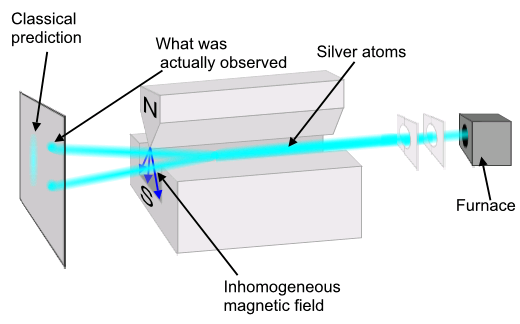 |
| (Sauce: wiki) |
This experimental result only made sense when one suggests that the particle carries an inherent angular momentum. Not only that, but this spin comes in discrete values. Imagine if you could only spin in your chair at specific speeds (lost in thought, too fast, and nauseating). And then forget that image, because you weren't actually spinning in any spatial direction, you merely contain "spin". Ridiculous, I know. As Zettili puts it, "The spin, an intrinsic degree of freedom, is a purely quantum mechanical concept with no classical analog".
As stated, spin comes in discrete values; specifically it comes in half-integer values - 0, 1/2, 1, 3/2, 2 (all multiplied by Planck's constant, as so many quantum characteristics are), and so on. Finally we approach the issue brought up at the beginning of this post: spin is the defining characteristics of bosons and fermions.
Bosons have "integral" spin; 0, 1, 2, etc. This class of particles most importantly contains the photon (and of course, the Higgs).
Fermions have spins like 1/2, 3/2, 5/2, etc, named "half-odd-integral spin" (because even halves like 2/2 is just 1). The most significant fermion is the electron, but also includes protons, neutrons and quarks.
So what's the importance of making this distinction?
 |
| (a) Asymmetric and... |
 |
| (b) ...symmetric wave functions (wiki) |
In the symmetric case, nothing particularly interesting occurs; you can effectively stuff as many bosons as you want into one space, and the wave function accommodates them quite pleasantly, not unlike being able to add as many musical notes to a chord as you like. The wave abides.
 |
| "That Higgs is really keeping this room together." |
However, in the asymmetric case, the wave function describing the state of multiple identical particles does a funny thing; if you pretend to put two fermions in the same state, the value of the wave function goes to zero. That is, such a wave function doesn't exist, can't exist, under the constraints of quantum mechanics. This results in the popular Pauli exclusion principle; try as you like, you simply can't stuff as many electrons as you like into one state: this exclusion repels the electrons away from each other, quite strongly. This "degeneracy" (multiple particles occupying the same energy level) is responsible for the relative "imperviousness of solid matter" in the case of electrons, and what keeps neutron stars from collapsing (as fermions, neutrons also are constrained by exclusion).
This principle is also the reason for electrons taking positions of increasing energy states in atoms. In fact, it is at the core of all atomic and chemical interactions. It defines much of the character of the periodic table as well. The rows are made by increasing the number of electrons within a "shell", with each subsequent row representing a larger shell, and each column representing similar "filling" of each shell. In fact, without this exclusion (that is, if electrons were bosons), the universe would be a very dull place indeed, as all the electrons of an atom would fall to the ground state, and all atoms would behave the same.
This all tells you pretty much nothing about the Higgs, but I hope it illuminates just a little bit more of the universe.
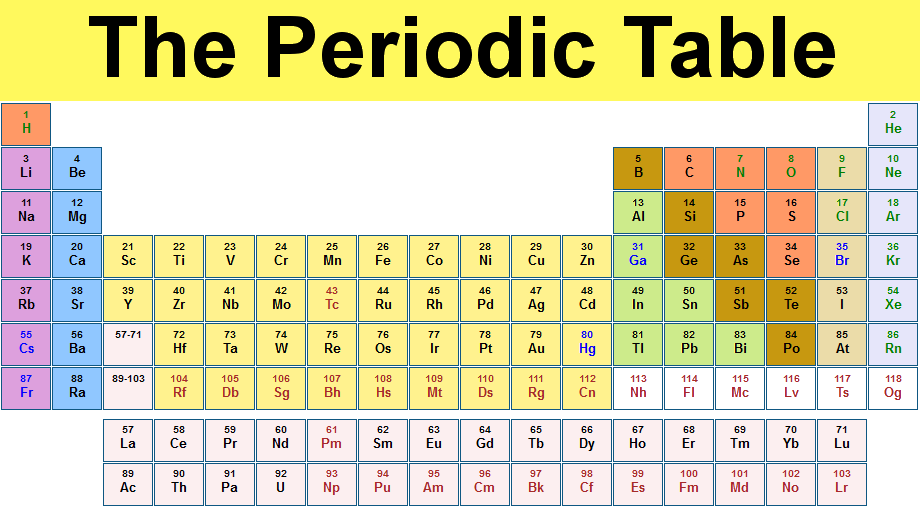 |
| (sauce: chemicool.com) |
Monday, November 19, 2012
Tidal Friction
Just put that on while you read this. I'm serious. Turn your nonsense off. That is sexy music.
Nay. It is sex music.
So, (he said, as though there were no such thing as a long absence), I was thumbing through this month's Discover, reading an interesting article on the possibility of life on other celestial objects in our solar system ("Frozen. Irradiated. Desolate. Alive?"), and came across this statement:
Although located a half-billion miles away from the sun, [Europa] receives a strong tug from the gravity of mighty Jupiter that warms the moon's insides.BRILLIANT!
Tidal forces, as readers very well know, can have significant effects on large things. But here on Earth, tidal forces are rather simple. Our moon has already settled into a synchronous rotation, always showing the same face. Like this!
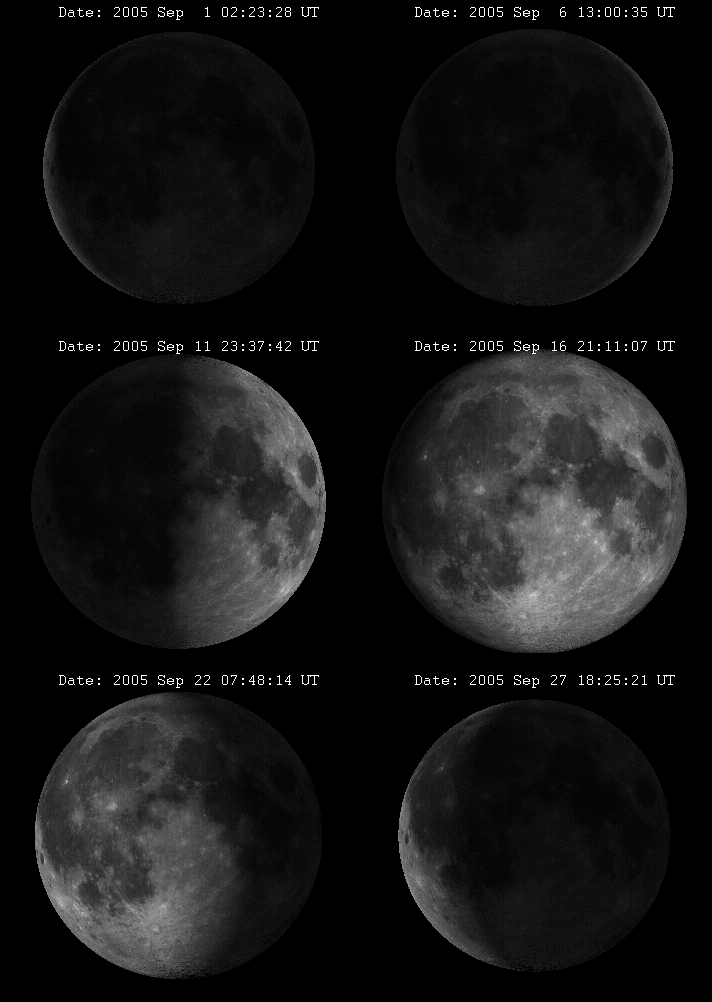 |
| (wiki) |
(Fun Fact: this gif is apparently going to play the entire time I type this. Blogger is weird.)
I say the moon 'settled' into that rotation, and I really do mean it. Nature, when unperturbed, tends to reach for the lowest potential energy needed to continue doing whatever it's doing. Back when the moon spun relative to Earth, there were indeed friction: imagine a point on the surface of a spinning moon, tracing out a spirograph-like pattern in it's orbit around the Earth. As that point draws away from the planet, it is fighting against a gravitational pull, that it's corresponding point on the opposite doesn't suffer: it's motion towards the Earth is actually strengthened. This asymmetry contributes to frictional forces that, over time, serve to slow the rotation of the moon (and indeed, to a slight extent, the Earth).
Friction is an agent of entropy - mathematically, you can consider it a dissipation term (in a different context, mentioned here), it makes for a more even distribution of energy, the result in this case being an 'easier' (lower energy) orbit.
But I digress.
The article was talking specifically of this tidal heating happening in Europa (Jupiter's second moon), but the most significant object in the solar system subject to this is Io, Jupiter's first moon.
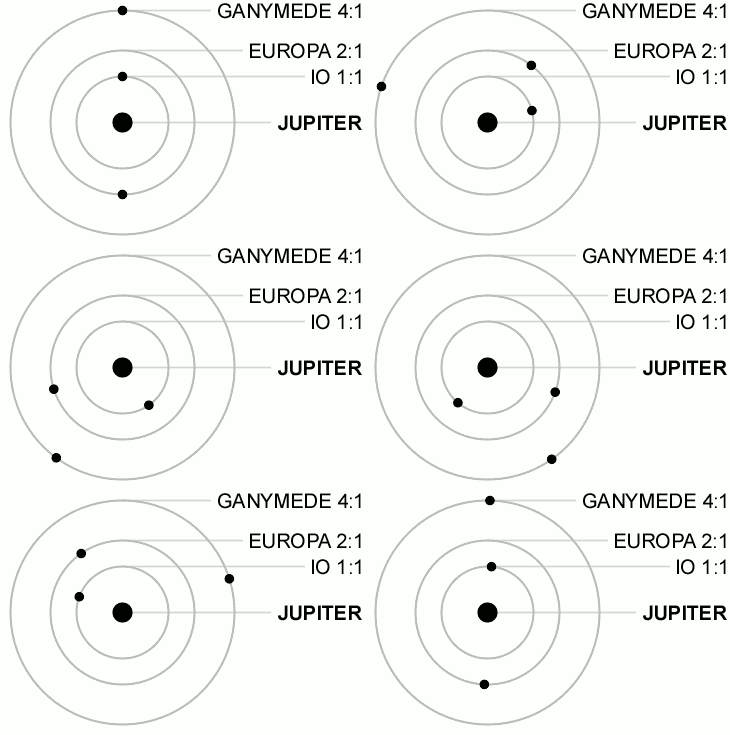
As I have literally just now learned, Io is in a resonant orbital period with Europa and Jupiter's third moon, Ganymede.
Fun Fact: their resonance prevent a triple conjunction (all three moons aligning on the same side) from ever happening.
 |
| (wiki) |
 |
| You are beautiful, Io. No matter what they say. |
Oh, and if you wanna learn about why it's so important on Europa, you'll have to read that article too. GOTCHA!
Monday, September 17, 2012
Pictures of Molecular Bonds
Photography! You know a little bit about it, right? You get a film or screen or some such, let some photons hit it for a while, and voila, you got yourself an image.
but you know about photons too. You know that if something is small enough, the momentum of photons is likely to knock them about. You may even know that the resolution is restrained by the wavelength of the photon - the longer the wavelength, the less their resolving power. Think of it like pixels - the larger the pixels, the worse the image. So how do you take a photo of something very, very tiny? You use something with a shorter wavelength, of course.
Like electrons! See, you could use visible light, around 400-700nm (billionths of a meter) to see...well, all the things you see, or X-Rays, at 0.01-1nm to go through tissue and bounce off denser material such as bone. But these are still general surfaces, much too blunt for our purposes.
Like electrons! See, you could use visible light, around 400-700nm (billionths of a meter) to see...well, all the things you see, or X-Rays, at 0.01-1nm to go through tissue and bounce off denser material such as bone. But these are still general surfaces, much too blunt for our purposes.
 |
| First "medical" X-Ray image: Roentgen's WIFE'S hand. Not what I would call chivalrous. (wiki) |
Monday, September 10, 2012
Gravity's Effect On Perception
You may have, at some point in your life, noticed gravity. Good! It's super-important.
Gravity has been with us for our entire biological evolution. Thus it only stands to reason that our biology would, when possible, take advantage of its influence. For instance, since gravity on Earth is always pointing downward (technically inward, as a central force), it makes for an extremely reliable vertical compass.
FUN FACT: the strength (and indeed, even direction) of gravity on the Earth's surface actually varies from location to location, dependent on factors like altitude, the local topography (say you had some mountains nearby) and geology (distribution of density).
Local gravity can even change over time, due to differences in water levels and such. Here's the gravity in South America shifting as the floods and recedes (holy snickerdoodles we're smart enough to watch gravity change from space):

Oh right I was going somewhere with this.
So, important and unavoidable as it is, gravity has been a perpetual influence in our evolution. How else would you walk and balance yourself, how else would you know the orientation of your head, if not for an ever-present acceleration?
It also makes sense that gravity's influence would have seeped into other aspects of our brain. Here we get to the whole point of this post: scientists conducted some visual illusion experiments on astronauts before, during and after trips into space, and found an interesting trend concerning vertical perception of these illusions.
Here's the Inverted-T illusion (wherein each line is actually the same length), with a graph detailing the perceived size difference by participants at various times:

They also asked participants to draw squares and crosses, measuring the horizontal-to-vertical ratio.

The extremely wide error bars are due to the small sample size, but the trend exists nonetheless. As they spend time in space, a seemingly gravity-induced perception of vertical length dissipates.
One of the primary causes of speciation (if not the primary cause) in biology is some sort of geographic or geologic separation. I can think of no geographic separation more significant than departing the planet altogether. As people take longer and longer trips (longest cumulative time belonging to Sergei Krikalev with 803 days), it will be interesting to see the effects on human physiology and psychology, and how that will confer benefits and differences. Sure, bone and muscle density decreases, but who needs bones in space?
h/t Neuroskeptic (amidoingitrite?)
Gravity has been with us for our entire biological evolution. Thus it only stands to reason that our biology would, when possible, take advantage of its influence. For instance, since gravity on Earth is always pointing downward (technically inward, as a central force), it makes for an extremely reliable vertical compass.
FUN FACT: the strength (and indeed, even direction) of gravity on the Earth's surface actually varies from location to location, dependent on factors like altitude, the local topography (say you had some mountains nearby) and geology (distribution of density).
 |
| Sauce |

Oh right I was going somewhere with this.
So, important and unavoidable as it is, gravity has been a perpetual influence in our evolution. How else would you walk and balance yourself, how else would you know the orientation of your head, if not for an ever-present acceleration?
It also makes sense that gravity's influence would have seeped into other aspects of our brain. Here we get to the whole point of this post: scientists conducted some visual illusion experiments on astronauts before, during and after trips into space, and found an interesting trend concerning vertical perception of these illusions.
Here's the Inverted-T illusion (wherein each line is actually the same length), with a graph detailing the perceived size difference by participants at various times:


The extremely wide error bars are due to the small sample size, but the trend exists nonetheless. As they spend time in space, a seemingly gravity-induced perception of vertical length dissipates.
One of the primary causes of speciation (if not the primary cause) in biology is some sort of geographic or geologic separation. I can think of no geographic separation more significant than departing the planet altogether. As people take longer and longer trips (longest cumulative time belonging to Sergei Krikalev with 803 days), it will be interesting to see the effects on human physiology and psychology, and how that will confer benefits and differences. Sure, bone and muscle density decreases, but who needs bones in space?
h/t Neuroskeptic (amidoingitrite?)
Thursday, September 6, 2012
Wicked Coronal Mass Ejection
So there was a gigantic explosion on the Sun the other day:
First of all: good gravy that is beautiful.
These cooled filaments (this one half a million miles long) are masses of charged particles held in place by the Sun's magnetic field. The Coronal Mass Ejection you see takes about an hour, and is traveling at 900 meters per second (about 2000 miles per hour).
Here's pictures at four different wavelengths (all in the X-Ray spectrum):

The variety of wavelengths helps scientists watch the change and distribution of temperature.
Even though it was directed away from us, the blast expands spherically, so we did catch some of the ejection about four days later, resulting in even more beauty, as charged particles smash into the Earth's atmosphere and emit Bremsstrahlung ('braking') radiation:

It's enough to make you think there might be something slightly dangerous about a slow, fiery nuclear explosion the size of 100,000 Earths.
http://www.nasa.gov/mission_pages/sunearth/news/News090412-filament.html
Sunday, September 2, 2012
How Energy Conservation Has Nothing To Do With Souls
Yanno what gets exhausting?
Hearing people apply one tiny little bit of scientific knowledge that
they do not understand to explain away their mystic nonsense. I try to be understanding – I get that it's hard to blame
someone for not knowing what they don’t know. But goddamn.
The conservation of energy is something I’m sure many people
have heard of. It’s an important
principle – no matter the interaction, the total energy at the beginning is the
same at the end – with vast and very useful applications (vast here meaning every phenomenon everywhere). There are in fact many conservation laws –
linear and angular momentum, spin, quantum number. Even probability in quantum mechanics is conserved! Unsurprisingly, I don’t hear about people
abusing those laws too often.
How do people abuse their limited knowledge of energy
conservation? It goes something like
this:
Energy is conserved, I don't want to believe I really die when my body dies; ipso-fucking-facto: souls/reincarnation/eternal
life/take your pick.
 |
| Totally real. |
I am not, near as I can tell, oversimplifying this stance. This idea that we – the self, the ego, the mind – are energy, and since energy is always conserved, surely our souls must live on after
death. Why, it’s conserved!
There are two ways to interpret this idea meaningfully, both wrong, but differently.
One, which is an idea I myself subscribe to, is that our minds are a particular configuration
of energy. A specific wavefunction, a
well-structured architecture generating subjective experience.
In this scenario, they are wrong because configurations are
not conserved. The strict organization of
your mind at this moment does not reflect the organization of all that energy
20 years from now. Really, even 20
minutes from now – that energy is being shuffled around and used and emitted
through chemical and electrical reactions.
Reactions that are changing the configuration. Meanwhile heat energy dissipates from your brain, heat energy that I doubt anyone would refer to as their self.
The other way is to suggest that there is something special
or significant in the energy they are considering. The problem here is that energy changing forms is exactly the significance of the principle. If a ball hits another ball and just transferred kinetic energy into more kinetic energy, nobody would be surprised (I hope).
But! When you hammer a nail into a board, the nail gets hot
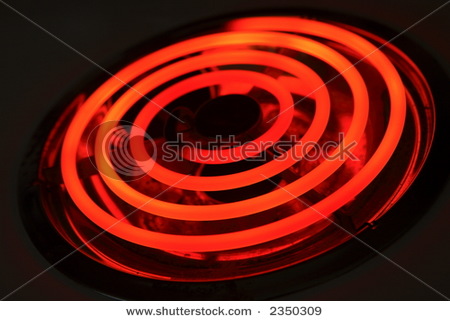
because some of that kinetic energy you just knocked into it caused frictional interaction between the nail and the board, jostling around the molecules which then dissipate this excitement through heat. In fact, if you were to hit it hard enough (insanely hard), that energy would be sufficiently high that the photons radiating would be within the visible spectrum. This is what's happening when electrical current is dissipated into heat on your stove.
 |
| Above: a stove with a spirit leak. |
Thus, if this mind-energy is special, and somehow stays in it's own form as it shits out of your dead-ass head, well then, that has nothing to do with conservation of energy, it is in fact something else entirely. Which is fine by me. Talk about your own voodoo magic on your own time. But don't co-opt scientific ideas just to pretend your idea has any legitimacy. It's downright rude.
Energy is one of those unfortunate words that has a well-established foot in both colloquial and scientific languages. We all "know" what the word means, we use it on a regular basis. So people can make the mistake of applying the definitions of the scientific version to their own. But when science defines a word, it defines the shit outta that word. There's no room for interpretation, no poetic license. Cut the malarkey, folks.
I know I've been gone for a while; I'm sorry, and you sweet people deserve better. I'm a changed man. I'm gonna make you coffee in the morning, and wash my own clothes, and stop muttering 'bitch' under my breath whenever you bring up your mother. Also, I'm gonna update regularly. September? More like Superber! Shit yeah!
Friday, July 20, 2012
Term O' The Day
Thagomizer: an informal name for the distinctive arrangement of four to ten spikes on the tails of stegosaurid dinosaurs.
The Far Side almost certainly holds the number one spot for comics taped up on the doors of scientists.

Nice.The term "thagomizer" was coined by Gary Larson in a 1982 Far Side comic strip, in which a group of cavemen in a faux-modern lecture hall are taught by their caveman professor that the spikes were named "after the late Thag Simmons". The term was picked up initially by Ken Carpenter, a palaeontologist at the Denver Museum of Nature and Science, who used the term when describing a fossil at the Society of Vertebrate Paleontology Annual Meeting in 1993.Thagomizer has since been adopted as an informal anatomical term, and is used by the Smithsonian Institution, the Dinosaur National Monument in Utah, the book The Complete Dinosaur and the BBC documentary series Planet Dinosaur.
The Far Side almost certainly holds the number one spot for comics taped up on the doors of scientists.

Friday, July 13, 2012
Dark Matter Filaments
Apologies for the radio silence here at Chez CK. Attention was required elsewhere. I've noticed a steady trend of people visiting this site each day (super exciting), which makes me feel guilty enough to make it up to you best I can. We'll start with a little bit of news that was overshadowed by the "particle just like the Higgs but we're only 99.9999% sure it's the Higgs which isn't sure enough" discovery.
You've probably seen this picture make its rounds on ye olde internetes. One is of neurons, the other is a simulated construction of the universe on an intergalactic scale. I'm not here to compare them, but it's the most popular picture I know of that shows a distinct feature of the arrangement of galaxies - the filament structure between superclusters.
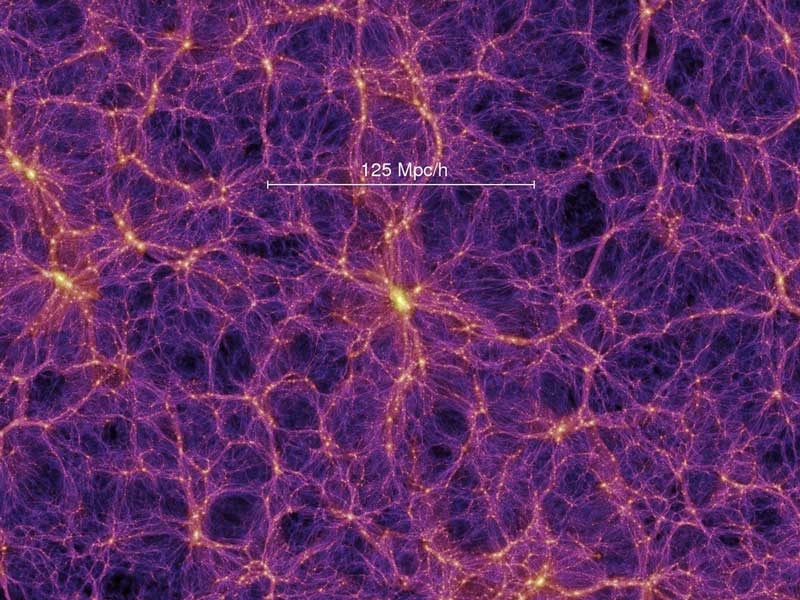
These filaments have been known for decades - I'm not sure when they were first spotted, but I'm sure it was in a galaxy survey not unlike this one:
Where the redshift of galaxies is used to to determine distance. This foamy, sponge-like structure is sometimes called the cosmic web, because everything astronomers name is badass.
This is not the type of thing light matter will tend to do on its own. The Lambda-Cold (cold meaning slow enough to be non-relativistic) Dark Matter model posits that dark matter started in the universe as a web that light matter was attracted to, and thus began to collect along these filaments. The distribution of dark matter wouldn't behave like the matter we're familiar with; it doesn't radiate photons so there's no temperature changes, it doesn't interact with electromagnetic fields, so it wouldn't bounce and jostle, or form molecules, and so on.
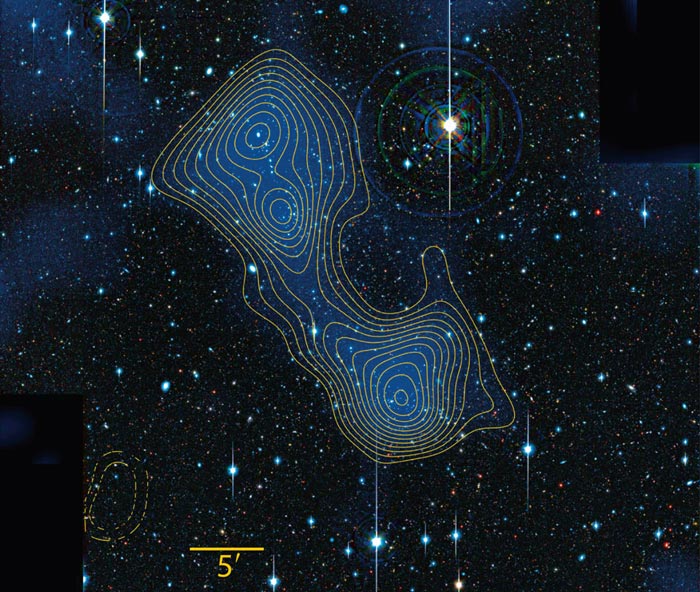
Anyhoos! We found a filament. The information came out at the same time as the Higgs announcement, so it got little play, but it's another brilliant discovery all the same.
This is an image of the gravitational lensing of two galactic clusters, Abell 222 and Abell 223, and the lensing in between them. This connecting lens also emits x-rays characteristic of hot gas, which would be expected to form along the filaments, but is too light to bend light as strongly as indicated.
It's not definitive, it doesn't completely eliminate competing models, it's no 99.9999% certainty, but discoveries in science often aren't. A model is by it's nature created to explain a wide variety of phenomena, so it takes a wide variety of phenomena to verify. And this is a great step in that direction. Another piece of the puzzle, a little bigger than the others.
 |
| (Sauce) |
These filaments have been known for decades - I'm not sure when they were first spotted, but I'm sure it was in a galaxy survey not unlike this one:
 |
| Ploink |
 |
| HuffPo |
Anyhoos! We found a filament. The information came out at the same time as the Higgs announcement, so it got little play, but it's another brilliant discovery all the same.
 |
| (Physics World) |
It's not definitive, it doesn't completely eliminate competing models, it's no 99.9999% certainty, but discoveries in science often aren't. A model is by it's nature created to explain a wide variety of phenomena, so it takes a wide variety of phenomena to verify. And this is a great step in that direction. Another piece of the puzzle, a little bigger than the others.
Tuesday, July 3, 2012
Brains Are Neat!
 |
| (Sauce) |
We all remember being a teen, smoking low-quality fatties with our pimply compatriots under the stars, asking impossibly irrelevant questions like 'what if god was a woman?' and 'you think Lincoln got stoned with former slaves?' And, surely, someone brought up the idea that the red you see isn't the same red they see.
What a ridiculous notion! We each have human brains, we went through similar development and construction of the basic areas of the brain. Our respective color-determining cortices are at least similar enough that its a small step to assume our perceptions are likewise the same. And we all seem to share similar emotional responses to similar colors. Same wavelengths, same physiology, same reactions - sure, we may not find the answer anytime soon, but we can make some solid presumptions.
Obviously, I'm not the funnest person to have 'What if...' conversations with. I can admit my faults.
And on the subject of admitting faults: it now seems likely that I was wrong. My apologies, my young stoner friends.
Wednesday, June 27, 2012
Two Great Developments For Our Electronic Infrastructure
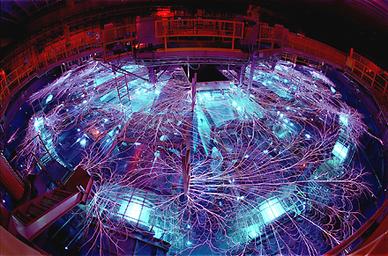
And one of them taught me about something I don't even recall hearing about: orbital angular momentum.
Since I'm wicked excited to dig deep into that, I'll start with the other first.
Sandia National Labs (who inspired me greatly years ago with a picture of their Z-Machine, up top), have created a new heat sink for computers. Now, I don't know all the ins and outs of cooling computers, but apparently they use both a heat sink and a fan to cool the chips. This new heat sink is the fan, which is mighty neat. It is apparently about 30 times more efficient at dissipating heat, drawing air down through the center and shooting it out through the sides, cooling the sink in the process.
This next one uses principles I had never considered, so we're gonna try to go a little in depth on this optical madness.
Monday, June 25, 2012
The Future Is Now
Seems like we've taken all that creativity and ingenuity in virtual worlds and begun applying it out here, via crazy-ass robotics. Our headspace is leaking into our meatspace, with wonderful consequences.
First, we have the clever idea of bypassing all the difficulty of dealing with terrain by avoiding it completely. A touch more noble than the tacocopter, I suppose.
The Matternet Vision from matternet on Vimeo
And then we have, as far as I know, the first flying band ever.
No, birds do NOT count.
First, we have the clever idea of bypassing all the difficulty of dealing with terrain by avoiding it completely. A touch more noble than the tacocopter, I suppose.
The Matternet Vision from matternet on Vimeo
And then we have, as far as I know, the first flying band ever.
No, birds do NOT count.
Friday, June 22, 2012
Oh, Be A Fine Girl...

One of the nice things about stars is that they are, in their own way, fairly simple things. Just a bunch of Hydrogen, some Helium, trace amounts of other elements, mushed together by gravity so powerfully that they ignited. Their general behavior is almost entire defined by the amount and proportion of their chemical makeup. And there's so very many stars knockin' about, we've cataloged enough to present a decent continuum of possible states.
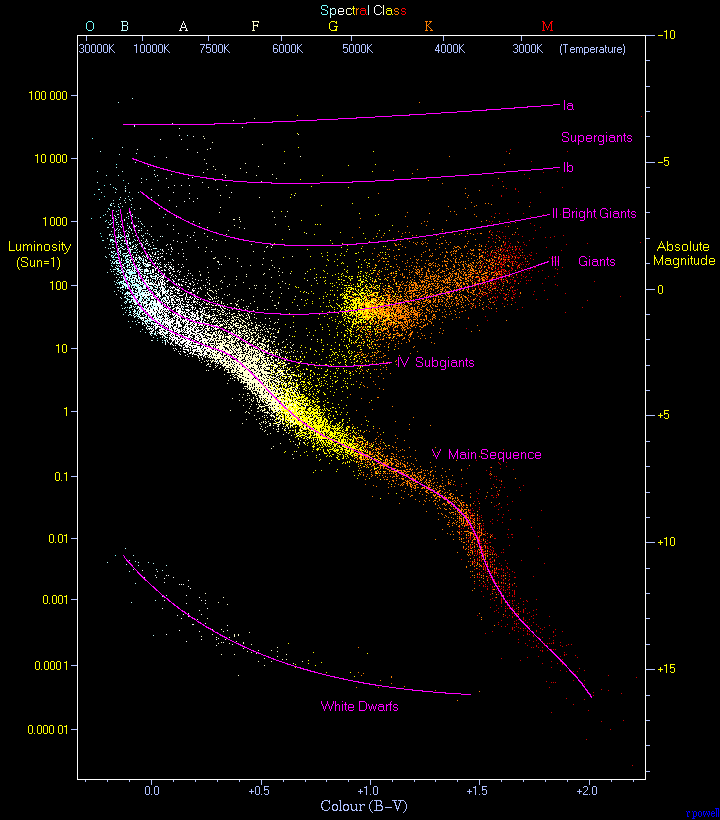
(23,000 stars plotted on an HR Diagram)
Another nice thing about stars is that we can basically see their insides, via the electromagnetic energy pouring out of the surface. This energy is characteristic of the reactions taking place. Spectroscopy studies this relationship between matter and photons.
There are three ways matter emits light that are of interest to scientists. One is the common black body radiation, based on the temperature of very hot things (when you see heated objects turn red, this is black body radiation). Because they're all jostling about, it forms a continuous spectrum. The second is emission spectra, which peak at wavelengths characteristic of the chemical reactions/electron excitations/ionizations. The third, the converse of emission, is absorption. When a continuous spectrum of light falls on some cool and mostly transparent gas, the gas can absorb specific wavelengths of light, leaving a vacancy in the continuity. Thus, the emission spectrum of a material has bright lines in the same place that it's absorption spectrum (with a continuous background) would have dark lines.
These are actually known as Kirchhoff's laws:
- An incandescent solid, liquid, or gas under high pressure emits a continuous spectrum.
- A hot gas under low pressure emits a "bright-line" or emission-line spectrum.
- A continuous spectrum source viewed through a cool, low-density gas produces an absorption-line spectrum.
Spectroscopy is the analysis of these laws; the light is sent through a diffraction grating, spreading it's differing wavelengths. Spectral analysis was already happening with materials on Earth for a few decades, but in the late 1800's Kirchhoff had the clever idea of aiming that analysis upwards. For the first time humanity knew that the objects up there were made of the same material as objects down here. As a quick example lets look at Helium, which was actually discovered in our sun 14 years before it was discovered on Earth, even deriving its name from Helios, Greek mythology's personification of the sun.
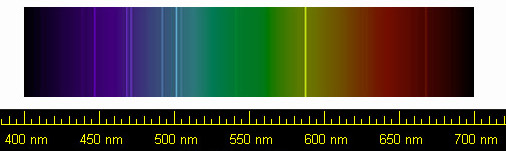
Helium Spectrum

Hydrogen Spectrum
Now, with quantum mechanics, we can understand the existence of these characteristic lines in terms of an electron raising or lowering its energy state.
So using spectroscopy, we can understand the composition of a star. We can know the temperature, by its black body radiation, and we know how much energy it takes to, say, ionize Hydrogen, so we know what's going on if we see that spectral line. Looking back up top, you can see how the cooler stars (O, B, A...) have two Hydrogen absorption lines (corresponding to the Balmer series), which imply that Hydrogen in its second excited state is absorbing photons. The hotter stars indicate the existence of Helium with it's characteristic yellow line. And this is all just along the range we're lucky enough to spot with our eyes. This analysis can take place across the entire electromagnetic spectrum.
It's almost too mad to consider: we can determine the chemical make-up of things we'll never go near, just by the information it beams outward - a story told in all directions of it's internal structure, so long as you're (scientifically) literate enough to read it.
Wednesday, June 20, 2012
Link: Dynamics of Political Ideologies
One of the major insights from works such as The Origin and Evolution of Cultures is that human societies can adapt and map themselves upon the environment with a few simple heuristics. A primary dynamic by which group behaviors propagate and enforce themselves is the do-what-my-neighbor-does rule-of-thumb. Obviously this is not always optimal. Sometimes it is needful to think for oneself. But thinking for oneself is cognitively expensive. Doing what everyone else does is cheap. Figuring out what you want to do for yourself is time consuming, and requires deliberation. There are analogies here between “hard & fast” reflexive cognition, and “slow & deliberate” reflective cognition.
Reading is good for you.
Monday, June 18, 2012
Diffraction In Your Camera (And Everywhere Else)
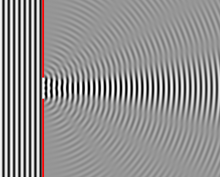
In the 'Oh, is that what that is?' category...
Diffraction, in the simplest description, is what happens when waves encounter objects. Their patterns tend to bend and distort, such as up top there, where plane waves become spherical waves by passing through a slit.
Light, as you might guess, experiences diffraction as well. Here's a schematic of light passing a sphere.

Irrelevant to today's topic, but those 'lines' extending to the right from the sphere are interference patterns. Where they are exceptionally bright, it is constructive interference, and the received light would actually be brighter than the original beam. The dark parts are destructive, and can actually result in no light being received.
And one day, when you're older, I'll tell you all about phase differences and explain that whole shebang.
But today isn't about that. Today is about a very familiar phenomenon to pretty much everyone: diffraction spikes. Take it away, NGC 6397!

Yeah, those things. Perhaps you'd like something more familiar, and we can accommodate.

You may have put two and two together by now. If you're gonna take a picture, you'll most likely need some lenses, maybe even a mirror. These items need to be held in place, with clips or rods or what-have-yeh. When the light hits these holders, it bends around them, distorting into these spikes once they get to the film/receiver.
One neat thing is that you can use these pictures to tell you how many holders, and the orientation of them.
Not everybody appreciates these spikes, so sometimes a person will close the aperture to exclude the outer circle, in some cases people even go so far as to manually remove the front part of a clip (if they had, for instance, a telescope they never intend on tipping forward).
Interesting to note: diffraction is dependent on the wavelength of the light, so that different colors of light will diffract at different angles. If you look back up at the nebula picture, you see an alternating blueish/reddish pattern. The interference pattern's intensity(number of photons) looks like this:

So that when you have a longer or shorter wavelength, the peaks shift outward or inward, respectively. If you do this with white light through a diffraction grating (a small sheet of material with hundreds or thousands of tiny slits to see through), you get a truly gorgeous result of light's wavelike behavior.

(That's a single wavelength on the top, with a full spectrum on the bottom)
You can see how the red light, with its longer wavelength, spreads out further and faster than the higher-energy, shorter-wavelength blue light.
Since I'm on the subject here, take an opportunity right now to curl up your forefinger so that only a little bit of light can get through it. Aim it between your eye and some white part of this screen, and adjust your 'aperture' as you peer through. You will notice little dark lines and dots showing up in the middle where nothing is touching. Those are spots of destructive interference, caused by your own hand!
And this is why it used to be so much easier to discover new laws of physics in your own basement.
Friday, June 15, 2012
Random vs. Non-Random Fractals

"Clouds are not spheres, mountains are not cones, coastlines are not circles, bark is not smooth, nor does lightning travel in a straight line." - Benoit MandelbrotOn occasion, I notice some confusion about fractals. Namely, about the difference between the idealized ones we create like the Sierpinski Gasket or Mandelbrot set, and the ones we see in nature, like trees/deltas/grass/lungs/nerves...well, all kinds of things, really. Folks will sometimes take one idea from non-random fractals - that they show self-similarity across all scales, forever - and combine it with two perspectives on the physical world - that the deeper we probe, the more we find, and that sometimes across some scales we find fractals.
Take that figure up top - the Sierpinski Gasket. Take a shape, like a triangle (Fun Fact: it doesn't have to start as a triangle, all shapes approach the same final behavior). Get three of those bad boys together and stack them as seen in the second figure. Take that shape and two of its friends, stack them similarly. Repeat for like, ever.
This is a nice, non-random, utterly unnatural, geometric fractal.
There are other ways to build fractals. The Mandelbrot set is a map of initial conditions. Basically, given some iterative sequence such as the one above, how does it end, given some initial value? Some visual aid for you:

So, if the iteration grows infinitely, it is not considered part of the set. If it dies down, or stays in some stable range, it is. Thus the black areas up there are all numbers which, when plugged into the iteration, result in some finite value. What you see is a map of initial conditions.
And as I'm sure you've held witness to before (one example of many), you can see how the entire shape is repeated on smaller scales, infinitely. Which is not to say it is infinitely complex. It is actually very simple, it just gives rise to a shape we have difficulty describing with our familiar geometries and intuition.
With me? Good.

Lets move on to random fractals. Naturally occurring self-similar patterns with boundaries. From From Newton To MandelBrot by Stauffer and Stanley:
...no non-random fractals are found in Nature. What is found are objects which themselves are not fractals but which have the remarkable feature that if we form a statistical average of some property such as the density, we find a quantity that decreases linearly with length scale when plotted on double logarithmic paper. Such objects are termed random fractals...The difference is that in the real world, patterns are made of things. They are not perfect mathematical objects without limitations. Fractal geometry will help you map a coastline, but zoom in far enough, and you find particles with no interest in deforming themselves to fit your notions. Ferns make for distinct fractal patterns within a few scales; a group of leaves made of smaller, similar groups of leaves, looking not entirely unlike the leaves themselves.

But notice, that's where the scaling, the self-similarity, ends. The cells don't look like the leaves, and I imagine a forest of ferns wouldn't look much like a fern either.
So these natural fractals only exist within certain bounds.
Say, while we're here, if you don't mind terribly, I'd like to put to rest a little notion that comes up here and there: The orbits of electrons and the orbits of planets are unequivocally not similar in any respect. One is held in place by its own momentum and the gravitational pull of the sun, while the other is held into place by strict and peculiar quantum mechanics and electromagnetic forces. Unless you can find us some planetary orbits that look like these...

Ok! Thanks for allowing me that.
So like I was saying, natural fractals don't exist on all scales, for various reasons. The universe is a very busy place, and just when you think a pattern may begin emerging, some parameter, some interference somewhere, tends to put a stop to it. Gravity is trivial at small sizes, get too big and you might crush yourself. A sand dune can never get as small as the grains that compose it.
The universe is a brilliant zoo of patterns. Geometric, fractal, exponential, periodic, chaotic (that is, utterly non-patterned). The rules governing scaling behavior, networked interactions, are used in research across the academic spectrum - chemists depositing chemicals onto substrates see them, botanists modeling plant growth use them, neurologists trying to understand the distinctly non-linear computing power of the brain are forced to address them.
But the universe itself is all those things and so much more.
I hope I get to share more of it with you.

Tuesday, June 12, 2012

The (Not) Faster-Than-Light Neutrinos
Hey, y'all remember when neutrinos exceeded the speed of light? Sure ya do! Scientists were befuddled, pseudo-scientists came out of the woodwork yelling 'SEE!? SEEEEE!?' as they like to do. Einstein was wrong, physics has to be rewritten, all that sensational nonsense.
So,short version: they didn't.

To recap, last year CERN produced some delightfully titillating results when they produced some neutrinos in an accelerator, and then shot them in the general direction of Geneva, some 450 miles away. One of the nice things, as you may recall from your favorite blog ever, about neutrinos is that their lack of electromagnetic interaction can send them through the Earth with little to no interaction with the planet itself, making it a primo substance for shooting directly from one city to another (and inducing a fevered pipe dream of using them for communications...). They made a most peculiar discovery: the neutrinos arrived about 60 nanoseconds quicker than the speed of light allows!
Now, these were fairly preliminary results, but the scientists at CERN had difficulty figuring out what could have been going wrong. For instance, the beams of neutrinos they were sending were potentially long enough to cause confusion (are we detecting the front exactly, or somewhere else?). Detection issues, departure and arrival issues, miscalculations; as exciting as it would be to deny a fundamental aspect of our physical model, what it really does to scientists is freak them the hell out.
One of the main points of contention involved the Supernova 1987A, discovered in...1987. A few hours before the visible light reached us, before we had any idea it was going on, three detectors around the world had an extremely active burst of detection; that is, a total of 24 between them in a 13 second period (remember, they usually only detect 1 or less per day).

Now, the light that arrived had to interact with all that interstellar matter, so it was slowed substantially. The end result, however, was that neutrinos traveled ever-so-slightly slower than the speed of light. And one would rightfully suspect that if neutrinos actually did travel FTL, it would become obvious over the 168,000 light years it traveled to get here.
A few months after these preliminary superluminality (Word of the Day) results, two problems emerged in their analysis; a malfunctioning clock, and a "leaky" fiber-optic cable. Correcting for those, now the final results are in, presented at the annual neutrino conference: the neutrinos made the 450 mile trip 1.6 nanoseconds after the speed of light would allow.
The universe's top speed holds steady, humanity makes some of the most accurate measurements in species history, and the world learns a lesson about preliminary findings.
Just kidding about that last one. We'll never stop being goofy.
Saturday, June 9, 2012
Lunar Tidal Forces and the LHC
Hey errybody! How've you been? Good, good.
Did you know the Moon is squeezing the Earth? It is indeedy. The Earth's generally pretty solid, so it can be hard to notice. Water however, is not quite so solid. Lucky us! The world would surely be less interesting without tides.
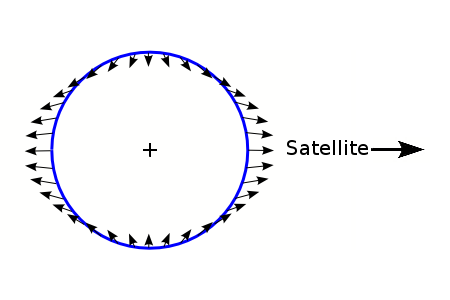
Up there is a schematic of the effects of a strong central gravitational force some distance away. For us, it causes tides, mostly due to the Moon, with about half as strong of an effect from the Sun. Heck, its even doing it to your mushy, watery body, just not with any strength we're capable of detecting (nor are we wide enough). (Fun Fact: these are the same forces that cause the popular "spaghettification effect" when falling into a black hole)
So what? Sew buttons! Because something like the LHC, about 3 miles wide, is indeed big enough to feel these effects. I'll let the shift leader at the time explain:
Data was coming in at a high rate and all sub-detectors were humming nicely. Not a glitch in hours so we were getting slightly sleepy nearing the end of the shift around 22:00. So when a colleague from the trigger system (the system that decides which events are worth keeping) called to inquire about recurrent splashes of data, I was rather puzzled.
I quickly went around, asking a few shifters to check their system. Nobody had a clue. Then I took a closer look at this plot that I had not scrutinized before since everything was so seamless.

What she was perturbed by were those dips in the lower two curves, which measure the intensity of the collisions.
So I called the LHC control room to find out what was happening. “Oh, those dips?”, casually answered the operator on shift. “That’s because the moon is nearly full and I periodically have to adjust the proton beam orbits.”Humans are amazing.
This effect has been known since the LEP days, the Large Electron Positron collider, the LHC predecessor. The LHC reuses the same circular tunnel as LEP. Twenty some years ago, it then came as a surprise that, given the 27 km circumference of the accelerator, the gravitational force exerted by the moon on one side is not the same as the one felt at the opposite side, creating a small distortion of the tunnel. Since the moon’s effect is very small, only large bodies like oceans feel its effect in the form of tides. But the LHC is such a sensitive apparatus, it can detect the minute deformations created by the small differences in the gravitational force across its diameter. The effect is of course largest when the moon is full.
Enjoy your weekend!
Subscribe to:
Posts (Atom)